How to start a travel baseball team
11 November 2026 · 5 min read
To start a travel baseball team you need an age group, two or three committed coaches, a sanctioning organization, insurance, a budget, a roster and a tournament schedule. None of it is complicated, but it has to happen in roughly that order, and most of it months before the first pitch.
This guide walks through the nine steps and the mistakes that sink first-year teams.
Before you start: is a new team the right move?
Starting a team is a season-long commitment of evenings and weekends. It makes sense when there are enough players at the right level without a team to play on, or when the existing options are too far, too expensive or not a good fit. If only your own child needs a team, joining an established one is easier.
If you do have a core group of five or six families who want the same thing, you have the hardest part already.
The nine steps
1. Pick the age group and level
Travel baseball is organized by age, written as 8U, 10U, 12U and so on up to 18U. Each sanctioning organization sets its own cutoff date for a player's age, so check it before you promise anyone a spot.
Then be honest about level. Most organizations sort teams into divisions by strength. A new team that enters the right division wins some games and keeps its families. One that enters too high spends the summer losing.
2. Recruit your coaches
You need a head coach and at least one or two assistants, so that practice still happens when someone is away. Decide early who makes playing-time decisions, especially if coaches have children on the team. Most organizations require background checks and safety training for every adult on the bench.
3. Choose a sanctioning organization
A sanctioning body gives you rules, age divisions, tournaments to enter and usually access to insurance. In the US the common ones for travel baseball include USSSA, Perfect Game, PONY and AAU. Teams often register with more than one so they can enter more tournaments.
Look at which organizations run the tournaments within driving distance of you. That matters more than any other difference between them.
4. Sort out insurance and the legal basics
You will need liability and accident insurance before you can book most fields or enter most tournaments. Many sanctioning bodies offer a team policy when you register.
Also decide how the team exists on paper. Some teams run as a simple parent-managed group with a dedicated bank account, and others form a nonprofit. A separate bank account is the minimum: team money should never sit in a coach's personal account. For anything beyond that, an accountant or attorney in your state can tell you what fits.
5. Build the budget and set the fee
Write down every cost for the season before you name a price:
- Tournament entry fees
- Sanctioning and registration fees
- Insurance
- Field rental and any indoor winter space
- Uniforms and hats
- Baseballs, catcher's gear and other equipment
- Umpire fees for scrimmages and league games
- Coach expenses, if you cover them
Add them up, add a small cushion, and divide by the number of players. Share the budget with parents line by line. Families accept a higher fee they can see through far more easily than a lower one they cannot.
Travel and hotels for away tournaments are usually paid by each family on top of the team fee. Say so in writing.
6. Hold tryouts and build the roster
A roster of 11 to 13 players is common: enough to cover absences and pitching limits, few enough that everyone plays. Younger teams often carry fewer.
Run an open tryout even if you already have a core group. It is fairer, and it finds the players you did not know about. Before you offer spots, tell families the fee, the practice schedule, the number of tournaments and how playing time works. Then collect the details you need in one team roster.
7. Secure fields and practice times
Field time is often the scarcest resource. Ask your parks department, local schools and the recreation league early, because permits for spring are frequently allocated in winter. Have an indoor option for bad weather and the off-season.
8. Plan the tournament schedule
First-year teams usually do well with a modest schedule: a handful of local tournaments, spaced so families get free weekends. Enter early, because popular events fill up. Keep one or two for later in the season, when you know how good the team is.
Publish the whole season as soon as it is set, using a schedule people actually follow.
9. Set up team communication before the first practice
Travel ball runs on logistics: who is coming, which field, what time to arrive, who still owes the second installment. Put that in one place from day one, and hold a parent meeting to agree expectations on attendance, playing time and money.
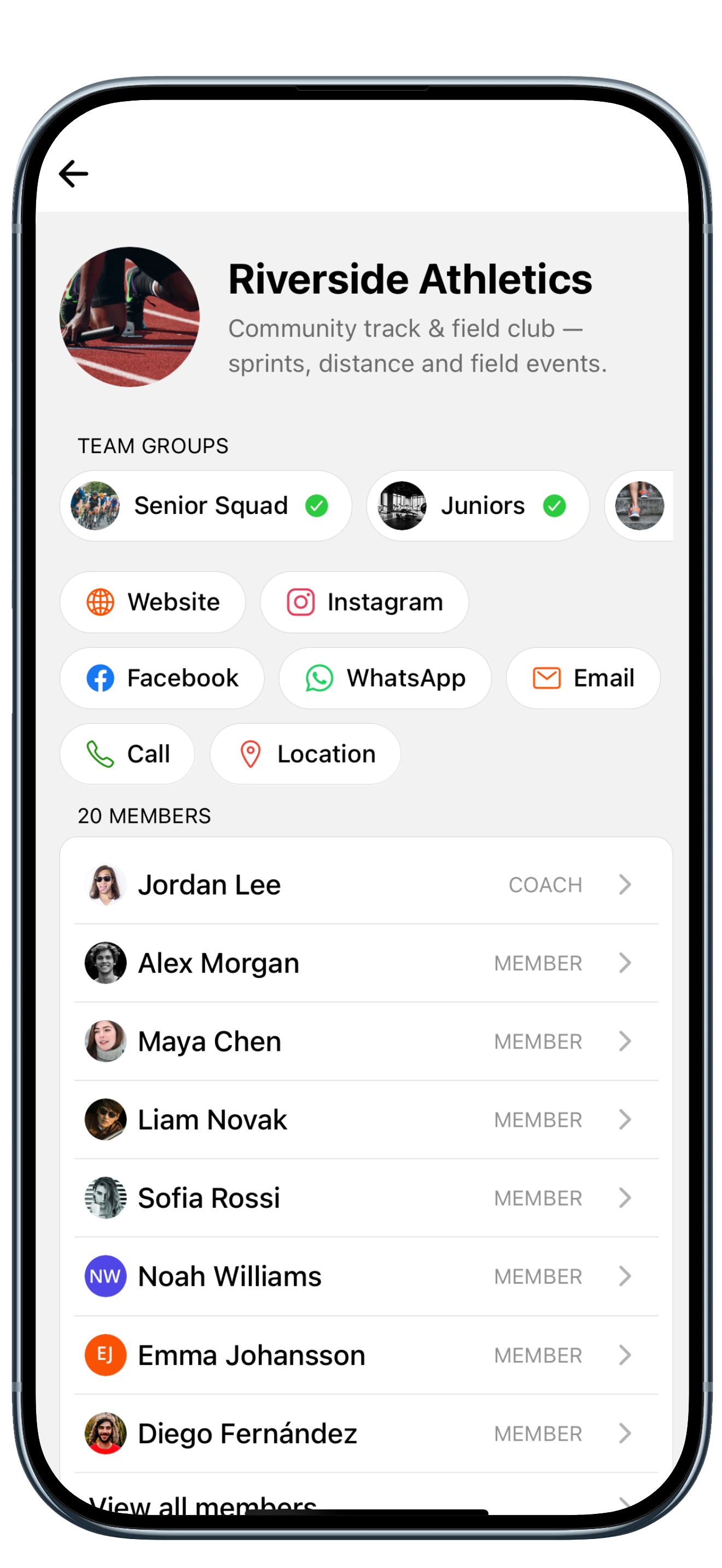
A baseball team app handles availability, messages and fee tracking together, which saves the group-chat roll call before every tournament. Our guide on how to choose a team management app covers what to look for.
A realistic timeline
| When | What to do |
|---|---|
| Six months or more before the season | Decide age group and level, recruit coaches |
| Four to five months before | Register with a sanctioning body, arrange insurance, draft the budget |
| Three to four months before | Hold tryouts, confirm the roster, order uniforms |
| Two to three months before | Book fields, enter tournaments, collect the first fee installment |
| The last month | Parent meeting, first practices, share the full schedule |
Many teams hold tryouts in late summer or fall for the following spring, so the calendar often starts earlier than new organizers expect.
Mistakes that sink first-year teams
- Too many tournaments. Burnout and cost drive families away faster than losing does.
- A fee with no breakdown. Money is the most common source of conflict. Show the numbers.
- Unclear playing time. Tell families before they commit whether time is equal or earned.
- One person doing everything. Give a parent the money, another the travel logistics and another the uniforms.
- No name or identity. A team the kids are proud of is easier to keep together. If you are stuck, here are team name ideas.
Quick answers
How many players do you need for a travel baseball team? Most teams carry 11 to 13. Nine take the field, and the extras cover absences and pitching rest.
Do I need to be a nonprofit to start a travel baseball team? No. Many teams start as a parent-run group with a separate bank account. Some form a nonprofit later for fundraising and tax reasons.
When should I start planning? About six months before your first tournament, and earlier if you want to hold fall tryouts.
What is the difference between travel ball and recreational baseball? Recreational leagues place every child who signs up and play locally. Travel teams select players by tryout and play tournaments against teams from other areas.
TeamCheck for your sport