
How to start a soccer team
11 November 2026 · 5 min read
To start a soccer team you need enough players for your format, a league or competition to enter, a registration with that league, a place to train and a way to collect fees and keep everyone informed. A youth team adds coaches and safeguarding checks. An adult team mostly adds a reliable way to know who is turning up.
Here are the eight steps, in the order they usually happen.
How many players do you need?
It depends on the format you play. In the US, youth soccer uses smaller teams at younger ages:
| Age group | Format | Sensible squad size |
|---|---|---|
| Under 6 to under 8 | 4 v 4 | 6 to 8 |
| Under 9 and under 10 | 7 v 7 | 10 to 12 |
| Under 11 and under 12 | 9 v 9 | 12 to 16 |
| Under 13 and older, and adults | 11 v 11 | 16 to 20 |
| Small-sided adult leagues | 5, 6 or 7 a side | Players on the field plus 3 or 4 |
Always sign a few more than the number on the field. Every team loses players to holidays, injuries and work.
The eight steps
1. Decide what kind of team it is
Three questions settle most of what follows:
- Youth or adult? Youth teams need coaches, parent communication and child-safety checks.
- Recreational or competitive? Recreational teams take everyone and share playing time. Competitive teams hold tryouts and travel further.
- Which format? Full 11-a-side needs a large squad and a full field. Small-sided soccer and futsal are far easier to start.
2. Find your core players
Start with the people you already have: classmates, colleagues, friends, parents at school. A core of six to eight committed players is enough to register a small-sided team and to recruit the rest. Community groups, school newsletters and local social media pages fill most remaining spots.
3. Choose a league
Most new teams join an existing league rather than arranging their own games.
- Youth teams usually join a local club or community league that is affiliated with a national organization such as US Youth Soccer, US Club Soccer or AYSO. Often the simplest route is to ask an existing club whether you can add a team at your age group, because the club already has registration, insurance and field permits.
- Adult teams can join a local amateur league, a city parks league or a commercial small-sided league that books the venue and referees for you.
Ask each league about the season dates, the cost per team, the standard of play and where games are held. For the usual calendar, see when soccer season starts.
4. Register the team and sort out insurance
The league will tell you what it needs: a team name, a roster with dates of birth for youth players, and a fee. Registration with an affiliated league normally includes player insurance, which is one of the main reasons to join one rather than playing independently.
For youth teams, coaches and team managers are usually required to pass a background check and complete safety training before the season. Allow a few weeks for that.
If you are stuck on a name, try these team name ideas.
5. Work out the costs and set the fee
List everything the team will pay for:
- League entry and player registration
- Referee fees, if the league charges them per game
- Field or facility hire for training
- Kit: shirts at minimum, plus goalkeeper gloves and a keeper shirt
- Balls, cones, bibs and a first-aid kit
Divide the total by the number of players, add a small cushion and tell everyone the figure before they commit. Collect it before the first game. Chasing fees mid-season is the job organizers dislike most.
6. Book somewhere to train
Leagues provide fields for games, but training space is usually up to you. Ask your parks department, local schools and community centers. Permits for popular evening slots go early, so ask as soon as you know the team is happening. Small-sided adult teams often skip formal training and simply play.
7. Get the kit and equipment
Order shirts in two contrasting colors, or a set of bibs, so you can always avoid a clash. Numbered shirts are required in most leagues. Players normally buy their own boots and shin guards.
8. Set up how the team communicates
A new team falls apart when nobody knows who is coming on Sunday. Decide before the first game where the schedule lives, how players confirm and who makes the final call on the lineup.
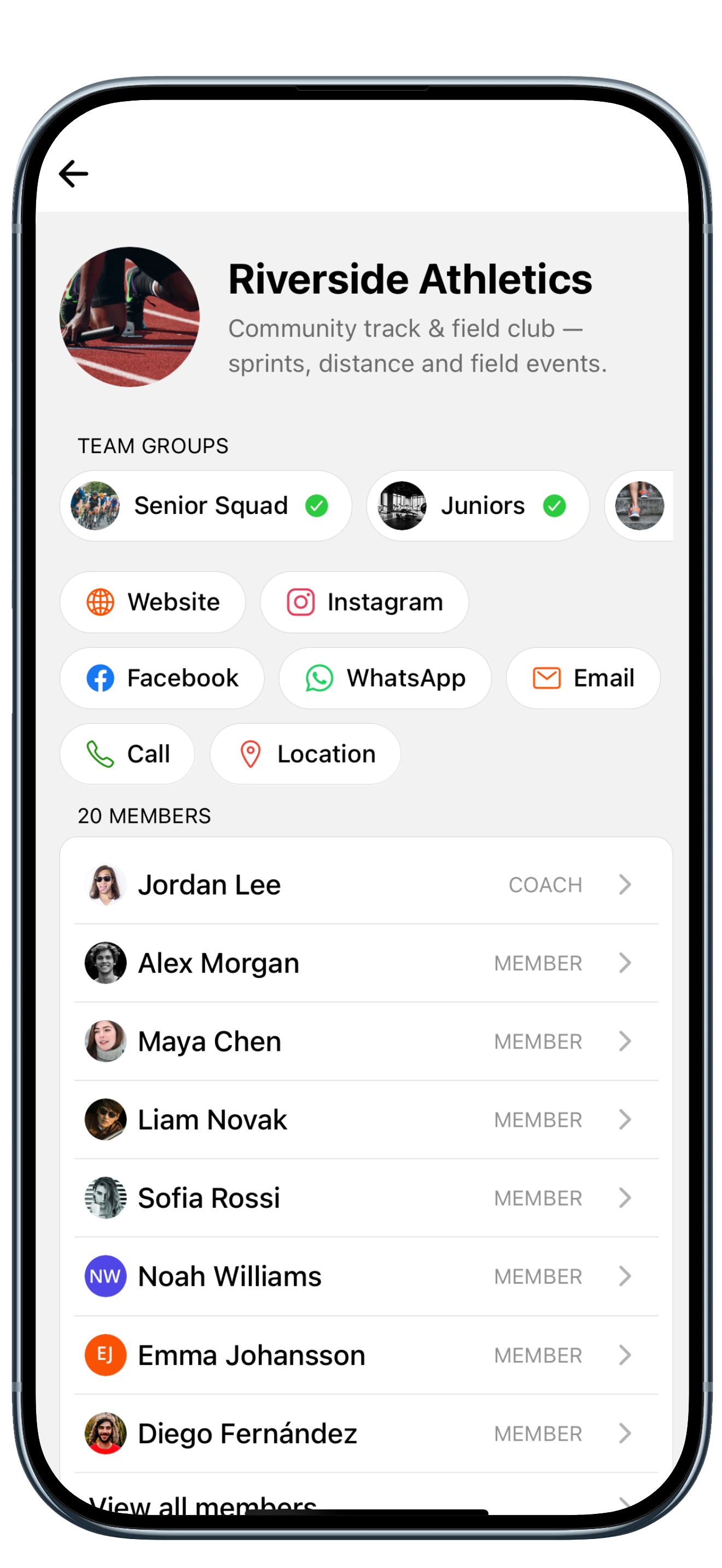
Put everyone on one team roster, share the fixtures as a schedule people actually follow, and ask for availability a few days ahead. A soccer team app does all three and tracks who has paid, without a group chat.
Youth teams: what is different
- You need coaches. At least two adults at every session. Many national organizations offer short introductory coaching courses for volunteers.
- Safeguarding comes first. Background checks and safety training are standard, and it is good practice never to have one adult alone with one child.
- Parents are part of the team. Hold a short meeting before the season to agree on playing time, behavior on the sideline and how you will communicate.
- Playing time matters more than results. At young ages every player should play a fair share of every game.
Adult teams: what is different
- Availability is the whole job. Sign a bigger squad than you think you need and ask for confirmations early in the week.
- Money up front. Collect the season fee before the first game, or per session if the league charges that way.
- Share the work. One person for money, one for the lineup, one for kit keeps the team going when the founder is away.
Quick answers
How much does it cost to start a soccer team? It varies widely with the league and the format. The main costs are league entry, referees, field hire and kit. A small-sided adult team in a league that provides the venue is the cheapest way to start.
Can I start a team without joining a league? Yes, for friendly games. For regular fixtures, referees and insurance, joining a league is much easier.
How long does it take to start a team? Allow two to three months before the season: time to recruit, register, complete any checks and order kit.
Do I need a coaching license? For a recreational team, usually not, though many leagues ask volunteer coaches to complete a short introductory course and safety training.
TeamCheck for your sport