






Handball clubs carry a heavier organizational load than their size suggests. A single club often fields eight or ten teams from minis to seniors, every one of them training twice a week in a hall that has to be shared, with away fixtures that need transport and a fee structure that funds all of it. Most of that work falls on volunteers. Here's what the job actually consists of, and where the time goes.
Hall time is the constraint everything else bends around
Handball is an indoor sport in places where indoor space is contested. A club's training schedule is not designed around what the coaches want; it's assembled from whatever slots the sports hall allocates, and it changes when the hall's other tenants change.
That has a knock-on effect that outsiders underestimate: a handball club's schedule is genuinely volatile. Slots move, sessions get bumped for a school event, two age groups get merged for a week. Every one of those changes has to reach a different set of players and parents, quickly and reliably.
Which is why announcements matter more here than in an outdoor sport with a fixed pitch. The single most common failure in a handball club isn't a lost match — it's twelve players arriving at a hall that's been given to someone else.
Pinned beats broadcast
A hall change sent as a chat message gets read by whoever was looking. Pinned to the session, it's still visible to the player checking their phone on the way out the door.
Training attendance and what coaches do with it
Handball training is technical and position-dependent. A session planned for sixteen doesn't downscale gracefully to nine, and a coach who finds out the numbers on arrival has already lost the first fifteen minutes of the session reorganizing.
Knowing in advance changes the session rather than just the mood. Fourteen means the planned six-on-six with rotations; nine means shooting drills and a different structure entirely. That decision is better made the night before with a plan than at 18:55 in a doorway.
Over a season, the accumulated record does a second job. Handball squads are large and playing time is contested, and attendance is the least controversial input into that conversation — it's a fact rather than an opinion, and everyone can see their own.
- Recurring sessions for each team's two or three weekly slots
- One-tap check-ins, so the coach has a number before leaving home
- Attendance history per player across the season
- Separate registers per age group under the same club
Match day: squads, keepers and travel
A handball match squad has a specific shape, and the part that causes the most anxiety is the goalkeepers. A team travelling with one keeper is a team hoping nothing goes wrong. Getting availability confirmed early is mostly about knowing whether you need to borrow one.
Away fixtures add the logistics layer that youth handball in particular runs on: who's driving, who has spaces, who's meeting at the hall and who's meeting at the club. This is traditionally a parents' WhatsApp group, where it works about as well as anything works in a WhatsApp group.
The improvement isn't complicated. Post the fixture, get structured availability against it, pin the travel details to that specific fixture rather than sending them into a chat, and the two most common away-day problems — missing keeper, missing car — become visible days ahead.
Ten teams, one club, one committee
The defining feature of a handball club is breadth. A modest club will run boys' and girls' teams at four or five age groups, plus a men's and women's senior side, and quite possibly a mini section that's really a childcare arrangement with a ball.
Every one of those teams needs its own schedule, its own coach, its own register and its own chat — and none of them should be receiving each other's notifications. Meanwhile the board needs a view across all of them, because the fee income and the hall allocation are club-level problems.
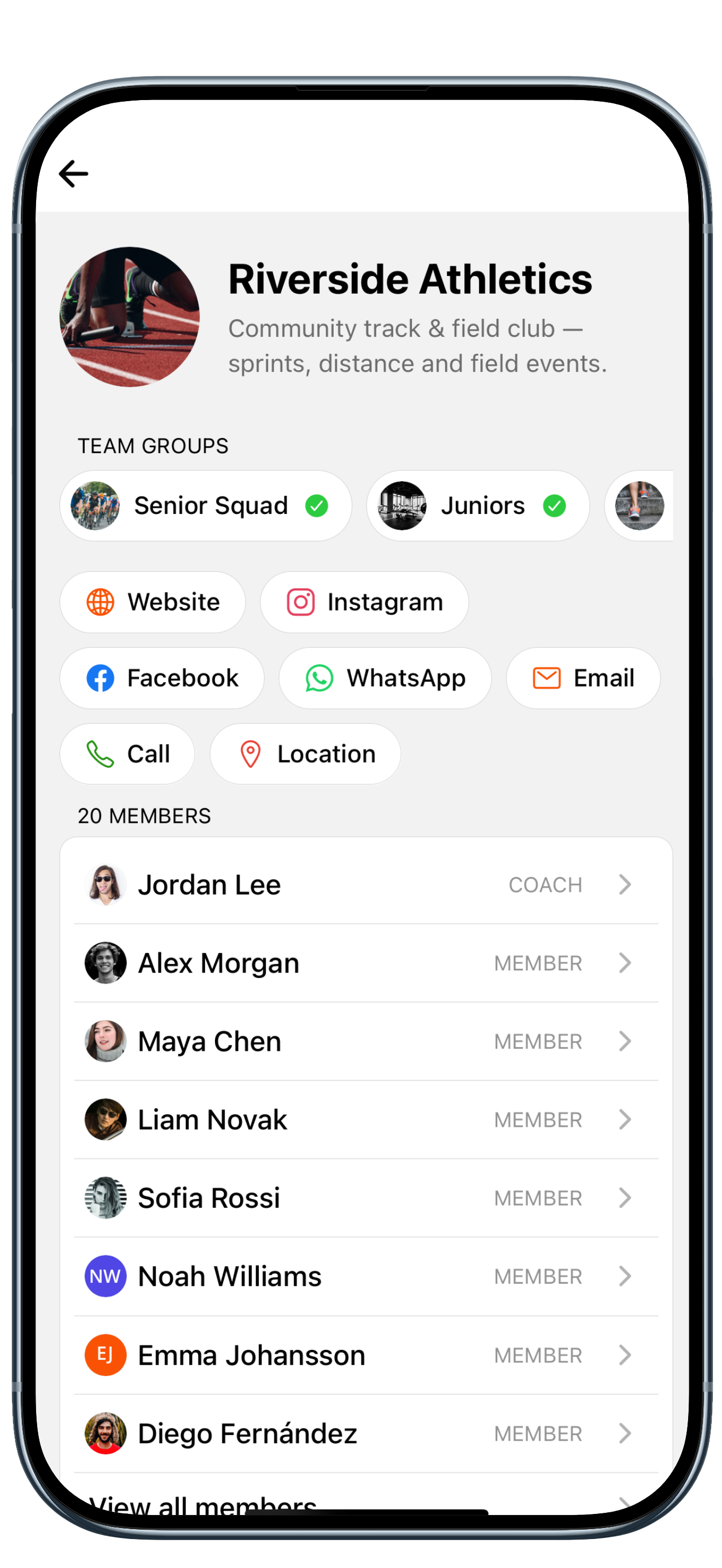
This is the specific thing a single group chat per team can't do. Ten chats is ten islands: no shared view, no consistent fee record, and a new parent gets added to the wrong one at least once a season.
- A group per team, each with its own schedule, register and chat
- Coaches assigned to their own teams; board members see the whole club
- Parents join the group for their child's age group, not the whole club
- One consistent record of fees across every team
Club fees, hall costs and away travel
Handball clubs are typically funded by an annual or termly membership fee, topped up by contributions for tournaments, travel and kit. The membership fee is predictable and the top-ups are not, which is why the treasurer's spreadsheet is always slightly wrong.
Splitting them properly helps: membership as a recurring payment that renews and reminds itself, and one-off charges attached to the specific tournament or trip they fund. Parents can then see what they paid for, which reduces the number of emails a treasurer receives by more than you'd expect.
The reminders are the real relief. In a club with two hundred families, chasing unpaid fees is not a task, it's a role — and it's the reason people resign from committees.
Let the app do the chasing
Automatic reminders go to the families who haven't paid, so nobody on the board has to have that conversation at the side of a court.